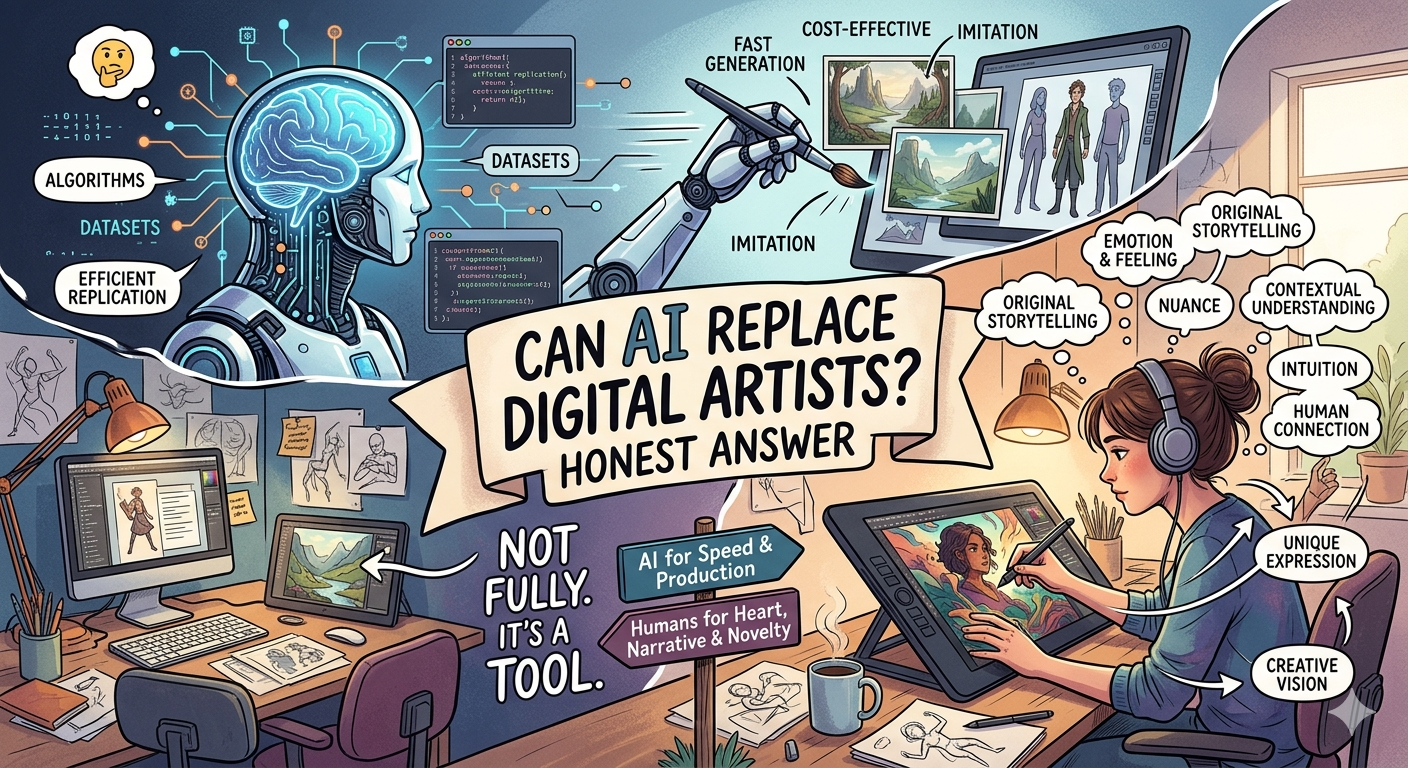
Most people asking “Can AI replace digital artists?” aren’t actually curious.
They’re scared.
Scared that years of learning composition, lighting, anatomy… might get replaced by a prompt box and a GPU.
I’ve been there.
I’ve tested AI art tools. I’ve tried selling AI-generated NFTs. I’ve even blended AI with hand-drawn workflows to see what actually works in the real world.
And here’s the honest truth:
AI is not replacing digital artists.
But it is replacing lazy ones.
Let’s break this down properly.
The Real Problem Behind “AI vs Artists”
The debate isn’t really about AI.
It’s about value.
Anyone can generate an image now. That’s not the bottleneck anymore.
The bottleneck is:
- Taste
- Story
- Identity
- Distribution
I tested this personally.
I generated 100+ AI artworks using different styles. Clean prompts. High-res outputs. Even trending aesthetics.
Result?
Zero sales.
Why?
Because no one knew who I was.
No one cared.
Meanwhile, I saw mediocre art from known creators sell instantly.
That’s when it clicked.
Art has never been just about the image. It’s about the context around it.
Can AI Replace Digital Artists? (Short Answer)
No.
But it can replace parts of the process.
Here’s a clearer breakdown:
| Area | AI Performance | Human Advantage |
|---|---|---|
| Speed | Extremely fast | Slower |
| Creativity (raw output) | High | Contextual creativity |
| Originality | Limited by training data | True originality |
| Storytelling | Weak | Strong |
| Branding | None | Essential |
| Emotional depth | Surface-level | Deep |
Unexpected insight:
AI is amazing at starting ideas. Humans are still better at finishing meaning.
What AI Actually Replaces (And What It Doesn’t)
What AI is replacing
- Basic commissions (logos, simple illustrations)
- Stock image creation
- Low-effort NFT collections
- Repetitive design tasks
If your work is:
“I can draw anything you ask me, fast”
Then yes — AI is coming for that.
What AI cannot replace
- Personal style built over years
- Cultural context and nuance
- Emotional storytelling
- Community-driven art
- Strategic creative direction
Strong statement:
People don’t pay for images. They pay for perspective.
I Tested AI Art for NFTs — Here’s What Failed
I created a small NFT collection using AI.
- 50 pieces
- Consistent style
- Clean metadata
- Even tried rarity traits
What failed?
- No narrative
- No audience
- No emotional hook
It looked good.
But it felt empty.
What Actually Worked (After Failing)
I changed strategy.
Instead of generating random art, I:
- Picked a niche (lonely cyberpunk characters)
- Wrote backstories for each piece
- Posted process videos (even if AI-assisted)
- Built a small audience before minting
Sales?
Still not huge.
But I got engagement. Comments. Saves.
That’s progress.
Unexpected insight:
AI art sells better when people see the process, not just the result.
The Core Insight: AI Is a Tool, Not a Creator
Think about it like this:
- Photoshop didn’t replace artists
- Cameras didn’t replace painters
- Tablets didn’t replace illustrators
AI is just the next tool.
But it’s a powerful one.
The artists who win are the ones who:
- Learn it early
- Combine it with their skill
- Use it strategically
Step-by-Step Framework: How Artists Stay Relevant in the AI Era
If you’re a digital artist (or planning to be), here’s a real framework.
1. Build a recognizable style
AI struggles with consistency across identity.
You shouldn’t.
- Same color palette
- Same themes
- Same mood
Make your work instantly recognizable.
2. Use AI for ideation, not final output
Use AI to:
- Explore compositions
- Generate references
- Test lighting
Then refine manually.
This hybrid workflow is powerful.
3. Document your process
People love behind-the-scenes.
Show:
- Prompt experiments
- Sketch to final
- Failures
Strong statement:
Process builds trust. AI alone doesn’t.
4. Build audience before selling
This is where most fail.
Don’t mint first.
Instead:
- Post consistently
- Engage in niche communities
- Share your story
5. Add meaning to your work
Even a simple piece becomes powerful with context.
Add:
- Story
- Message
- Personal connection
Real-World Examples (What I Observed)
Example 1: Pure AI Artist (Failed Fast)
- Generated 200 images
- Uploaded to NFT marketplace
- No audience
Result: No traction.
Example 2: Hybrid Artist (Slow Growth, Real Results)
- Uses AI for base
- Paints over manually
- Shares process
Result:
- Growing following
- Better engagement
- Higher perceived value
Example 3: Story-Driven Creator (Best Outcome)
- Simple visuals
- Strong narrative
- Community-driven
Result:
- Loyal audience
- Consistent sales
Common Mistakes to Avoid
1. Relying only on AI output
Anyone can generate images.
That’s not your edge.
2. Ignoring branding
If people can’t recognize your work, you’re replaceable.
3. Skipping storytelling
Art without context is decoration.
4. Chasing trends blindly
Trends die fast.
Style lasts.
5. Not building distribution
No audience = no sales.
Simple.
⚡ 5 Actionable Tips (Use This Now)
[Save this section]
- Pick a niche and stick to it for 30 days
- Post your process, not just final art
- Use AI for drafts, not finished pieces
- Write 1–2 sentences of story per artwork
- Engage daily with creators in your niche
Advanced Insights Most People Miss
1. AI reduces skill barrier, but increases taste competition
Now everyone can create.
So the real competition becomes:
Who has better taste?
2. Distribution beats creation
You can be average and win with audience.
You can be amazing and lose with no reach.
3. Hybrid artists will dominate
The future isn’t AI vs human.
It’s:
AI + human vs everyone else
4. Imperfection becomes valuable
AI is too perfect sometimes.
Human flaws = uniqueness.
Monetization Angle: Where the Money Actually Is
If you’re thinking income, here’s reality:
Low earning potential:
- Selling random AI art
- Generic NFT collections
- Stock-style images
Higher earning potential:
- Personal brand + art
- Commission work with AI assistance
- Content creation (YouTube, TikTok)
- Digital products (tutorials, presets)
Smart monetization stack:
- Free content → builds audience
- Paid content → monetizes attention
- Art → premium layer
Unexpected insight:
Your content might make more money than your art.
Future Trends (2026 and Beyond)
1. AI-native artists will rise
Creators who start with AI won’t see it as a threat.
They’ll dominate.
2. Collectors will value “human touch”
Hand-drawn elements will become premium.
3. Story-driven NFTs will outperform
Not just images.
Worlds.
Characters.
Lore.
4. Tools will get better — but taste won’t scale
This is your edge.
✔️ Quick Checklist (Before You Publish or Sell Art)
- Do I have a clear style?
- Does this piece have a story?
- Would someone recognize my work instantly?
- Am I building an audience consistently?
- Am I using AI as a tool, not a crutch?
If you answered “no” to 3+…
Fix that first.
FAQ (High-Value, Straight Answers)
Can AI replace digital artists completely?
No. AI can automate parts of the process, but it lacks storytelling, identity, and emotional depth.
Is AI art still profitable in 2026?
Yes, but only with strategy. Random AI art rarely sells. Audience + narrative matters more.
Why do most NFT projects fail?
Lack of attention. Not bad art. No audience, no story, no demand.
Should artists learn AI tools?
Yes. It’s a competitive advantage. Ignoring AI puts you behind.
How much can you realistically earn from NFT art?
Beginners: $0–$500
With audience: $1K–$10K+
Top creators: much higher
It depends more on reach than art quality.
Final Verdict: Can AI Replace Digital Artists?
No.
But it will expose who actually brings value.
If your only skill is “making images,” you’re at risk.
If you can:
- tell stories
- build an audience
- create meaning
You’re not being replaced.
You’re becoming more valuable.
Final thought:
AI didn’t kill art.
It raised the standard.
Adapt, and you win.