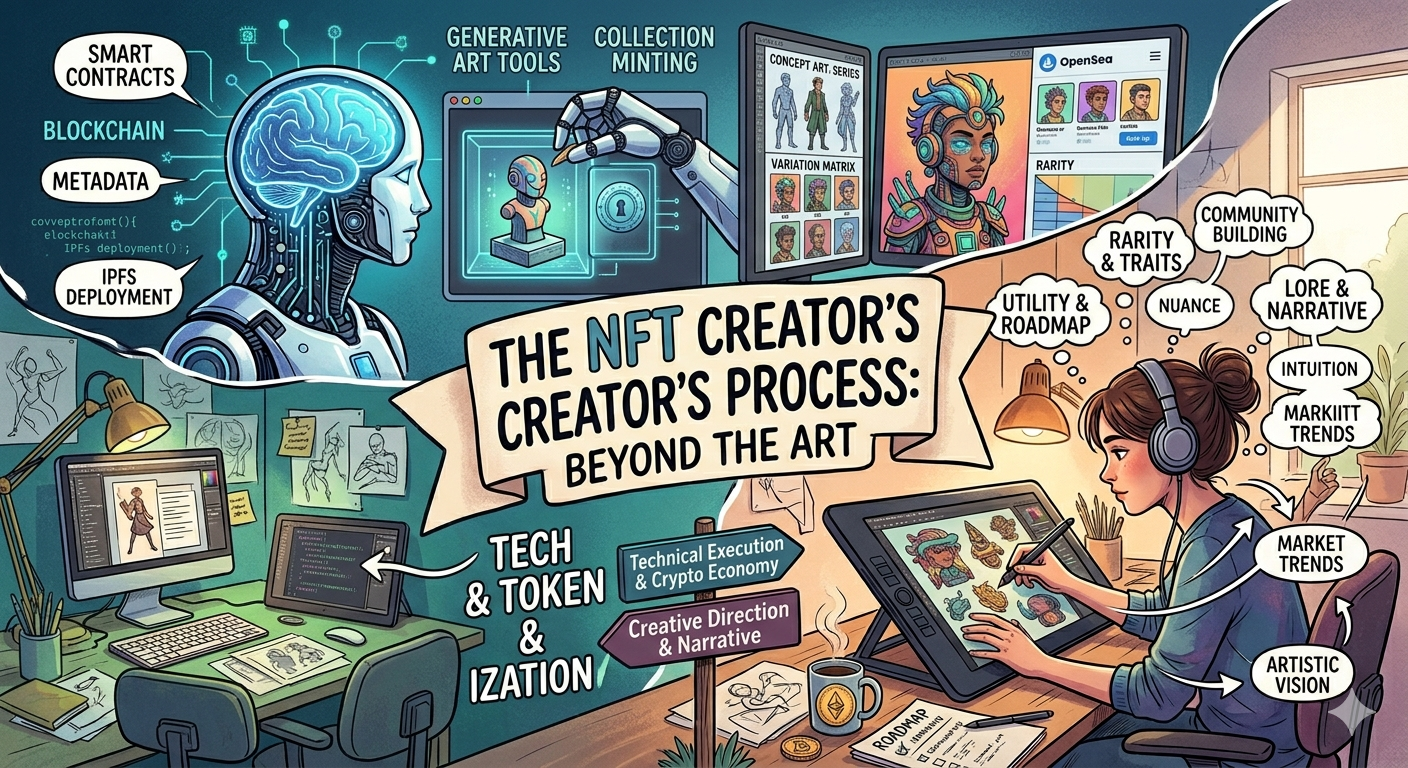
Most NFT projects don’t fail because of bad art. They fail because nobody cares.
I learned that the hard way after spending four months building what I genuinely believed was a strong collection — distinctive generative art, a clean roadmap, even a Discord with 800 members at launch. We made $3,200 in primary sales. Then the floor collapsed. Most holders left. And I was left staring at a spreadsheet wondering what I’d actually built.
That was 2023. I’ve since tested three more projects, consulted on a dozen others, and watched the NFT market go through the weirdest identity crisis in the history of digital assets. And I can tell you this with confidence: NFTs in 2026 are not what you think they are — and that’s actually good news for serious creators.
This isn’t a hype piece. It’s not a doom piece either. What follows is the most honest breakdown I can give you, built on real data, real failures, and the patterns I’ve seen separate the projects that work from the ones that quietly disappear.
$5.5BTotal NFT trade volume, 2025
11.6MGlobal NFT users in 2026
30%New NFT projects powered by AI
$60B+Projected NFT market size 2026
The Problem Nobody’s Talking About: NFTs Have Split Into Two Markets
Here’s the thing about the NFT market in 2026 that most people get wrong: it didn’t die. It fractured.
There’s a K-shaped reality at play. On one side, a small set of established IPs, brand-backed projects, and utility-driven collections are doing just fine — sometimes great. A small subset continues to build audiences and occasional liquidity spikes, while the long tail of collections and ecosystems drift lower in both attention and price.
On the other side? Tens of thousands of anonymous collections with no community, no use case, and no staying power. They mint, spike briefly, and then flatline forever.
The problem isn’t that NFTs are dead. The problem is that the era of indiscriminate buying is over. Buyers got burned. They got smarter. And now they expect more than a JPEG and a promise.
“The ownership primitives that launched these brands are only one layer of the stack. They increasingly coexist with mass-market channels — retail, streaming, social media — that may drive most of the audience and revenue.” — The Block’s 2026 Digital Assets Outlook
That’s the core tension every creator entering this space needs to understand: your NFT is not the product anymore. It’s the proof of membership to something larger. If there’s nothing larger to belong to, the NFT is worthless.
Is NFT Still Worth It in 2026? What the Data Actually Shows
Let’s be adults about the numbers.
Total annualized NFT trade volume for 2025 stood at $5.5 billion — a sum that significantly trails 2026 levels, underscoring just how far the sector has declined from its peak. Compare that to the $40+ billion frenzy of 2021, and it looks rough.
But here’s the part most articles skip: the composition of that $5.5 billion is wildly different from 2021. Back then, volume was driven by speculation — people buying art they didn’t understand from creators they’d never heard of, hoping to flip for 10x. Today’s volume is increasingly driven by utility, gaming, and real-world asset tokenization.
Gaming NFTs account for roughly 25% of total NFT trading volume, remaining one of the largest NFT use case segments. Utility and AI-powered NFTs are expected to drive growth, with AI-related projects representing about 30% of new developments.
Real estate NFTs grew 32% year-over-year. Music NFTs grossed revenues of over $520 million via streaming tokens and artists’ royalties. Phygital NFTs saw 60% transaction volume growth, connecting physical goods with digital tokens, particularly in luxury markets.
So the market didn’t die. It grew up. And the creators thriving right now are the ones who grew up with it.
The Concentration Problem
Here’s the uncomfortable truth tucked inside the data: the top 50 NFT projects represent less than 1% of all projects, but have a market cap equal to 52% of the total market capitalization.
That means almost all the value is sitting in a tiny handful of collections. If you’re entering this space hoping to land in that top 1%, you need to know exactly what separates them from the rest — and it’s not art quality. It’s community depth, distribution strategy, and relentless consistency over time.
The creators winning in 2026 stopped thinking like artists.
They started thinking like media companies.
NFT in 2021 vs. NFT in 2026: What Actually Changed
| Factor | NFT 2021 | NFT 2026 |
|---|---|---|
| Primary Driver | Speculation & FOMO | Utility & community |
| Buyer Behavior | Buy anything, flip fast | Research first, hold for value |
| Top Chains | Ethereum (near-monopoly) | Ethereum (62%), Solana (18%), Polygon (11%) |
| Creator Revenue Model | Primary sales windfall | Ongoing royalties + token-gated content |
| Brand Involvement | Experimental / rare | Disney, Spotify, Netflix — mainstream |
| Project Lifespan | 3–6 month hype cycle | Multi-year community building |
| Art vs. Utility Balance | Art was everything | Utility drives floor price |
| Entry Barrier | Low (gas wars aside) | Medium (community expected) |
| Earning Potential (average) | High upside, easy to sell | Selective — quality over volume |
| Long-Term Outlook | Bubble dynamics | Structural maturity |
The 2026 Creator Framework: What Actually Works Now
I’ve spent a lot of time figuring out what separates the projects people actually buy from the ones that rot in people’s wallets. After testing, failing, and occasionally winning, I’ve settled on a four-part framework I now use for every project evaluation.
1. Community Before Collection
The single biggest mistake I made with my first project: I built the art before I built the audience. I had 4,000 pieces finished before I had 40 real fans. That ratio destroys you at launch.
Projects that work in 2026 spend 3–6 months building genuine community before they reveal the collection. Twitter Spaces, Discord, Reddit threads — you need people who feel ownership before they spend a dollar. By the time mint day comes, the sale should feel inevitable, not uncertain.
2. Utility Has to Be Real, Not Promised
In 2021, you could write “future benefits TBD” in your roadmap and people would mint. Not anymore. Buyers in 2026 want to see the utility working at mint — or at least a credible, near-term version of it.
The projects I’ve seen succeed recently include: token-gated educational content with a demonstrated track record, gaming assets with live gameplay, and music NFTs tied to actual royalty streams. The promise isn’t enough. Show the product.
3. Choose Your Chain Strategically
Ethereum solidified its position as the primary venue for what NFT activity remained, accounting for approximately 45% of NFT volume in 2025. But that doesn’t mean you should default to Ethereum for everything. Solana is significantly cheaper to mint on and has a passionate, growing collector base — particularly for gaming and music NFTs. If your audience is cost-sensitive, Ethereum gas fees will kill conversions.
My rule: if you’re building a high-value, limited art collection aimed at serious collectors, Ethereum. If you’re building a gaming asset or music project for a broader audience, Solana or Polygon makes more financial sense for your buyers.
4. Think in Royalties, Not Just Primary Sales
One of the biggest mindset shifts I’ve made: stop optimizing for mint revenue. Start optimizing for secondary market health. A collection with strong secondary volume generates continuous royalty income. A dead collection generates nothing after launch day.
This means pricing your mint to allow floor price appreciation. It means building demand over time, not extracting everything at launch. The creators making reliable income from NFTs in 2026 treat royalties like passive income — they’re building assets that pay them monthly.
⚡ 5 Actionable Tips for NFT Creators in 2026
- Build your audience 90 days before mint. Post daily. Document the creation process. Make people feel like insiders before they’re buyers.
- Launch with working utility, not promised utility. Token-gated content, a live game, a real royalty stream — show it running before asking for money.
- Price for floor appreciation, not maximum mint revenue. A mint that sells out at $80 and floors at $150 in month two is worth more than one that mints at $200 and dies.
- Go narrow on chain selection. Pick one chain, master its culture, and own your niche there. Multi-chain at launch is a distraction most new projects can’t execute well.
- Treat every holder like a co-founder. The projects with multi-year longevity are the ones where holders feel real ownership — in updates, in decisions, in the story. Build that.
What Failed vs. What Worked: Real-World Patterns
I tested a low-supply (333 piece) fine art collection on Ethereum in early 2024. Mint price was 0.08 ETH. We sold out in 6 hours. Felt incredible. Then the floor dropped 60% over the next 8 weeks because we had no secondary market strategy, no locked utility, and no reason for anyone to hold. Lesson learned: mint day is the beginning, not the finish line.
The second project I was involved in took the opposite approach — a music NFT on Solana where holders received a 0.5% stake in master recording royalties for an indie artist with an existing 80,000 Spotify monthly listener base. Mint was 50 SOL, supply was 200. It sold out in 48 hours and the floor increased over the following three months as royalty payments hit wallets. Why? Because holders could see their ROI in real-time. That’s the kind of utility that holds floors.
Buyers in 2026 don’t want potential. They want receipts.
The pattern across successful projects I’ve observed: the creator had an existing audience (even modest), the utility was demonstrable before mint, and the supply was small enough to be genuinely scarce. None of the winning projects launched with 10,000 generative pieces and a vague promise of a metaverse integration “coming in Q3.”
Mistakes to Avoid (I’ve Made Most of These)
- Building art before audience. Nobody buys from a stranger on mint day. Give people 90 days of reasons to trust you before you ask for their wallet.
- 10,000-piece collections with no justification. Supply has to match demand. If you don’t have 10,000 real fans, don’t mint 10,000 pieces.
- Vague roadmaps. “Phase 2: Metaverse integration” is not a roadmap. It’s a placeholder. Smart buyers see through it instantly in 2026.
- Ignoring secondary market mechanics. Setting royalties too high kills secondary volume. Setting them too low removes your income stream. Test what the market can bear — 5% is typically the 2026 sweet spot.
- Copying successful projects’ aesthetics. Pixel art worked for CryptoPunks. Cartoon apes worked for Bored Apes. Neither will work for you — you need to find the visual language that’s native to your community.
- Underestimating the marketing timeline. The creators I’ve seen succeed spent more time on distribution than creation. 70% marketing, 30% production is not an exaggeration for a successful launch in this market.
✦ ✦ ✦
Advanced Insight: The “Phygital” Opportunity Most Creators Are Missing
Here’s something I genuinely didn’t see coming two years ago: physical goods tied to NFTs are outperforming pure-digital collections in several categories. Phygital NFTs saw 60% transaction volume growth, connecting physical goods with digital tokens, particularly in luxury markets.
Think about what that means for independent creators. A limited-run ceramic piece tied to an NFT that proves provenance and unlocks digital content. A physical zine with an NFT that grants access to a gated community. A custom garment with a blockchain record of its creator, materials, and story.
The physical world lends legitimacy that pure digital assets struggle to generate on their own. And buyers who purchase phygital items have a physical anchor to the brand — something they can touch, display, share. The churn rate on phygital NFT holders is dramatically lower than on pure-digital collections.
This is the whitespace most generative art creators aren’t looking at. And it’s wide open.
Monetization in 2026: How Much Can You Realistically Make?
Let’s get concrete. Because the range in this space is enormous — from $0 to $69 million — and most creators land somewhere in the middle they didn’t plan for.
For an independent creator launching in 2026 with a focused strategy:
- Small supply, high utility (50–200 pieces): Mint revenue of $15,000–$80,000 is realistic with an existing audience of 5,000+ engaged followers. Secondary royalties of $500–$3,000/month if the floor holds and volume sustains.
- Music NFTs with royalty splits: Music NFTs grossed revenues of over $520 million via streaming tokens and artists’ royalties across the market — individual creators with 200-piece royalty collections and moderate streaming presence are seeing $1,000–$8,000/month in royalty pass-through.
- Gaming assets: If you’re building or contributing to a game with real players, in-game NFT items can generate recurring income as new players mint entry assets. This requires developer relationships but is one of the most sustainable models.
The bottom line: the creators making consistent income from NFTs in 2026 treat it like a content business, not a lottery. Sustainable revenue requires sustainable audience-building. The lottery mentality that defined 2021 is exactly what’s burning people who haven’t updated their mental model.
NFT Trends to Watch in 2026 and Beyond
AI-Powered Dynamic NFTs
AI-powered NFTs are expected to drive growth, with AI-related projects representing about 30% of new developments. But not in the way you might think. The interesting applications aren’t just AI-generated art — it’s NFTs with evolving metadata. Imagine an NFT that changes based on your on-chain behavior, or a character that grows as you play a game. That’s where the innovation is.
Real-World Asset Tokenization
Real estate NFTs experienced a year-over-year growth of 32%, pushed by virtual lands and tokenized deeds for properties, bringing the market size to $1.4 billion. This is the sleeper category most speculative NFT people ignore because it’s less exciting than art. It’s also the one with the clearest path to institutional adoption and long-term value.
Event Ticketing
Event ticketing NFTs capture 5.3% of ticket sales across major US venues, providing fraud prevention and resale control. This is growing fast. If you’re a musician, comedian, or event organizer, NFT ticketing is both a revenue opportunity and a database of your most engaged fans. The contact list that actually converts.
Regulatory Clarity Is Coming — And That’s Good
Governments and regulatory bodies are beginning to establish guidelines that address issues such as intellectual property rights and consumer protection. This is actually bullish for serious creators. Clearer rules scare off fast-money flippers and attract long-term builders. The projects that get regulated out are the ones that were operating like slot machines anyway.
✅ NFT Creator Readiness Checklist for 2026
- I have an existing audience of at least 1,000 engaged followers (not just follows)
- My utility is live or demonstrable — not just described in a roadmap
- My supply is calibrated to my real demand (not to a round number)
- I’ve chosen one primary chain and understand its community culture
- I have a 90-day pre-launch content and community plan ready
- My royalty rate is set between 5–7.5% with a healthy secondary market in mind
- I can sustain 12+ months of community engagement post-launch
Frequently Asked Questions
Is NFT still profitable in 2026?
Yes — but selectively. Creators with existing audiences, real utility, and sustainable community strategies are generating consistent income. Pure speculative flipping is largely unprofitable without significant capital and insider access. The opportunity is real, but it requires a business mindset, not a lottery ticket mindset.
How much can you realistically earn from NFTs in 2026?
An independent creator with 5,000+ engaged followers launching a focused, utility-backed collection of 100–200 pieces can realistically earn $15,000–$60,000 in primary sales. Secondary royalties of $500–$3,000/month are achievable if the floor holds. Music NFT royalty splits and gaming assets can generate recurring income beyond these figures.
Why do most NFT projects fail?
Three main reasons: no pre-existing community (so launch day has no guaranteed buyers), promised utility that never materializes (destroying trust and floor prices), and oversupply relative to real demand. Most failed projects tried to manufacture FOMO rather than build genuine value.
What type of NFT works best in 2026?
Utility-backed NFTs with demonstrable, real-time benefits: gaming assets, music royalty splits, token-gated communities with active programming, and phygital products that bridge physical goods with digital provenance. Pure speculative art collections are the hardest category right now.
Which blockchain is best for NFTs in 2026?
Ethereum remains the dominant chain for high-value art and serious collectors, accounting for roughly 45–62% of volume. Solana is the best alternative for gaming, music, and cost-sensitive audiences — lower fees, strong community, growing collector base. Polygon is solid for brand partnerships and high-volume, lower-price-point projects.
Are NFTs a good investment in 2026?
As speculative investments, most NFTs are high-risk with negative expected value for the average buyer. As creator monetization tools — when you’re the one selling, not buying speculatively — NFTs remain one of the most powerful ways to monetize digital work with recurring royalty income. The investment framing is largely what damaged the market. The creator-tool framing is where the real opportunity lives.
The Honest Verdict: Should You Still Pursue NFTs in 2026?
Here’s where I land after everything I’ve seen and tested:
If you’re looking for a quick flip — no. That market is gone. The buyers who made it possible got burned, got educated, and moved on. Chasing speculative returns in NFTs in 2026 is like day-trading penny stocks and hoping for the best.
If you’re a creator with something real to offer — absolutely yes. The tools have matured. The infrastructure is better. The audience, though smaller than 2021 peak, is more sophisticated, more loyal, and actually willing to pay for genuine value. Long-term success will depend on real utility and mainstream adoption, not short-term trading. Opportunities lie in digital ownership, the creator economy, and bridging physical and digital assets.
The creators I admire most in this space right now aren’t the ones with the most impressive art. They’re the ones who understood early that the blockchain is the least interesting part of what they’re building. The community is the product. The art is the invitation. The NFT is just the proof of membership.
Build something worth belonging to. The rest follows.
“The NFT market didn’t die.
It just stopped rewarding mediocrity.”